

The Millennium Project Special Studies

- Publisher: Millennium Project (August 15, 2022)
- Language: English
- Download UN Foresight Element report (English)
- Download UN Foresight Element report (Chinese)
- Download UN Foresight Element report (Spanish)
- Download UN Foresight Element report (Italian – Executive Summary)
The United Nations takes on the Future: The Millennium Project Assessed the Best Strategies
UN Secretary-General António Guterres issued Our Common Agenda, a bold report on UN reforms that includes five foresight elements that are: UN Futures Lab, UN Summit on the Future, UN Envoy for Future Generations, Periodic UN Strategic Foresight and Global Threats reports, Re-purposed UN Trusteeship Council as a Multi-Stakeholder Foresight Body. The Millennium Project just released an international strategic assessment of how to implement each to improve global foresight.
Real-Time Delphi (RTD) questionnaire asked how critical each of the five element was to improving the effectiveness of global foresight; what and who would make this element successful, and what features would make it most effective; and additional strategies to implement the element.
The study was conducted in association with The Millennium Project’s 70 Nodes around the world (groups of individuals and institutions), along with the World Futures Studies Federation, and the Association of Professional Futurists.
The RTD panel of 189 futurists and related international experts from 54 countries overwhelmingly endorsed and will support the five foresight elements of Our Common Agenda, as an integrated and interdependent system: the success of each one affects the success of all the others.

- Publisher: The Millennium Project (October 20, 2020)
- Language: English, Chinese
Three Futures of the COVID-19 Pandemic in the United State, January 1, 2022
Implications for all of us
This report contains the three scenarios, plus an introduction, executive summary, conclusions, detailed lists of implications, readiness, list of low probability events that could change the scenarios, and an appendix with results from four Real-Time Delphi studies that was used as input to the scenarios plus the list of over 250 participants in these studies.
The three scenarios incorporated input from over 250 medical doctors, public health professionals, emergency relief staff, economists, and futurists in five US and international Real-Time Delphi studies (a unique interactive survey process). These studies assessed the possible best, worst, and most likely conditions by January, 2022.
Read more about the report and download the translations of the executive summary in other languages.

- Publisher: The Millennium Project; 1 edition (August 1, 2014)
- Language: English; Spanish
- ISBN: 978-607-00-4892-0
FUTURES is the most comprehensive futures studies encyclopedic dictionary that exists to date. It comprises over 1,000 terms and methods used in futures studies. The work was initiated and coordinated by Concepción Olavarrieta, with review and edits of terms done by Theodore Gordon and Jerome Glenn, and with the contribution of more than 500 futurists from The Millennium Project network.
It is available in English and Spanish.
It can be downloaded as pdf file, or purchased as a CD.
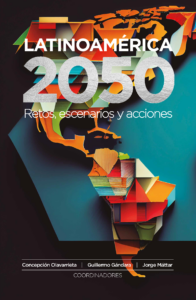
Latinoamérica 2050. Retos, escenarios y acciones
by José Luis Cordeiro et al.
- Publisher: Franz Tamayo University — UNIFRANZ
- Publishing date: September 2023
- Language: Spanish
- ISBN-13: 978-9917-9703-0-9
The Mexico and the Bolivia Nodes of The Millennium Project recently published a new book on “Latin America by 2050. Challenges, Scenarios and Actions“ (Latinoamérica 2050. Retos, escenarios y acciones), launched the publication during the Futures Week event. Coordinators and authors of the book are Concepcion Olavarrieta, Chair of the Mexico Node, Guillermo Gándara and Jorge Máttar, members of the Mexico Node.
25 Latin American futurists, from ten different countries develop, based on the concept of the 15 Global Challenges facing humanity by The Millennium Project and their holistic impact, an in-depth diagnosis of the main threats and opportunities that are currently and will be facing the Latin American region if current trends happen in the field.
The book consists of two parts. In the first, each of the authors and co-authors, after presenting their analysis on trends, present their positive vision to achieve change and formulate their reflections on what could be improved. In the second part, they formulate 3 Scenarios and invite the readers to think about the futures that the region will face. In the last part of this section, the authors and co-authors conclude with basic ideas or criteria for the development of projects and immediate actions to be implemented in terms of public and private policies that will help achieve the best future for the region.
Latin America 2050 is the result of a joint effort of RIBER, regional Node of The Millennium Project, it’s promoted and coordinated by the Mexico Node, and published by the Bolivia Node, chaired by Verónica Agreda (Rector of Universidad UNIFRANZ hosting the Node), with the support of UNDP.
The methodology of this book can be replicated in other regions of the world and for professors is an excellent tool for teaching. This current edition of the book is in Spanish but the authors are currently working on an English edition.
For more information, you can contact our Mexico and Bolivia Nodes.
Identification of Potential Terrorists and Adversary Planning — Emerging Technologies and New Counter-Terror Strategies
Edited by Theodore J. Gordon, Elizabeth Florescu, Jerome Glenn, and Yair Sharan

Never before have technological advances had so great an impact on security — not only increasing the nature and level of threats, but also for the possibility of providing the means to address the threats. Technologies that could increase security include ubiquitous and omnipresent surveillance systems, the use of new algorithms for big data, improving bio- and psycho-metrics, and artificial intelligence and robotics. Yet trustworthy and reliable partners and an active and alert society remain sine qua non to reduce terrorism.
“To my mind, this publication is one of the best studies of modern terrorism and what to do about it that we have at our disposal. So I am confident that it will find a wide readership, not only in academic or think tank circles, but even more importantly, among policy makers and government officials. They stand to benefit most and they can afford least of all to ignore the important conclusions and recommendations that this wise publication has provided.”
Jamie SHEA
Deputy Assistant Secretary General,
Emerging Security Challenges Division, NATO
Lone Wolf Terrrism Prospects and Potential Strategies to Address the Threat
by Theodore J. Gordon, Yair Sharan, and Elizabeth Florescu

- 200 pages
- Electronic (downloadable PDF) or Paperback print format
- ISBN: 978-0-692-45554-8
We believe that a new kind of arms race is developing. On one hand, is the possibility of increasingly destructive weapons falling into the wrong hands, and on the other, the development of new methods of surveillance and pinpointing individuals with malintent. Will the methods of detection be adequate and timely enough to avoid catastrophe? It is often said that one of the major purposes of futures research is to provide lead-time to decision makers and the decision process; we have lead-time. We hope it will be used to reduce the threat we see in front of us.
Albert Einstein is supposed to have said, “The world will not be destroyed by those who do evil, but by those who watch and do nothing.” We hope we have done something with this book.
Order the paperback from Amazon.com
List of Previous Millennium Project Futures Research*
- African Futures Scenarios 2025, and UNDP workshop at the UN (1994)
- Millennium Project Feasibility Study final report (1995)
- Global Issues/Strategies four-round Global Lookout (Delphi) study (1996)
- Lessons of History (1997)
- Global Opportunities and Strategies Delphi (1997)
- Environmental Security: Emerging International Definitions, Perceptions, and Policy Considerations (1997)
- Futures Research in Decision-making (and checklist) (1998-99)
- Exploratory Scenarios (1998)
- Global Normative 2050 Scenario (1998)
- Environmental Security Threats and Policy Leadership (1998)
- Factors Required for Successful Implementation of Futures Research in Decision Making (1999)
- Current/Potential UN military doctrine on Environmental Security (1999)
- Five Very-Long Range (year 3000) Scenarios (1999-2000)
- Science and Technology 2025 Global Scenarios
- Future Technological Implications for Society and the UN System (2000)
- World Leaders on Global Challenges; UN Summit (2001)
- Environmental Crimes in Military Actions and the International Criminal Court (ICC)––UN Perspectives (2001)
- Management Implications of Future S&T 2025 Issues (2001)
- New Military Environmental Security Requirements 2010-2015 (2001)
- UN Millennium Summit: World Leaders on Global Challenges (2000-2001)
- Counterterrorism Scenarios; Scenarios, Actions, and Policies (2001-2002)
- Monthly Reports: Emerging Environmental Security Issues (2001-2015)
- Global Goals for the year 2050 (2002)
- Future S&T Scenarios 2025 (2002)
- Emerging Environmental Security Issues for Future UN Treaties (2002)
- Future International Environmental Security Issues and Potential Military Requirements over the period of 2010 to 2025
- Middle East Peace Scenarios (2002-04)
- Early Warning System for Kuwait Oil Company (2003-04)
- Nanotech Military R&D Health/Env Research Prevention Priorities (2004-05)
- Future Global Ethical Issues (2004-05)
- Measuring and Promoting Sustainable Development (2005)
- Global Energy Scenarios (2006-07)
- South Korea SOFI (2006)
- Future of Learning and Education 2030 (2007)
- Global Climate Change Situation Room for Gimcheon, South Korea (2007-2008)
- Conceptual design for global energy collective intelligence (GENIS) (2008)
- Status of Government Future Strategy Units (2008)
- RT Delphi for UNESCO World Water Report (2008)
- Declaration of Human Rights WFUNA Human Rights (2008)
- Decision Criteria Evaluation of Global Environment Facility (2008)
- South Korea SOFI and South African SOFI (2008)
- Early Warning System PMO Kuwait (2008-2009)
- Potential Future Elements of the Next Economic System (2009)
- UNESCO World Water Scenarios project (2009)
- Future of Ontologists (2009)
- Future Hopes and Fears: a Kuwait Perspective (
- Egypt 2020 (2010) 2010-2011)
- Latin America 2030 Scenarios (2009-2011)
- Changes to Gender Stereotypes (2011)
- Azerbaijan SOFI (2011)
- Future Arts, Media, and Entertainment: Seeds for 2020 (2011)
- Annotated Scenarios Bibliography (1996-2012)
- Cooperatives 2030: Factors Impacting Future of Cooperatives and Business (2012)
- Egypt’s national Synergetic Information System (ECISIS) (2013-16)
- Hidden Hunger: Unhealthy Food Markets in the Developing World (2013)
- Vulnerable Natural Infrastructure in Urban Coastal Zones (2013)
- FUTURES Dictionary/Encyclopedia (English and Spanish) (2014)
- SIMAD and Lone Wolf Terrorism Counter Strategies (2014)
- Czech Rep., Hungary, Poland, Slovakia, Visegrad Region SOFIs (2014-2015)
- Water-Energy-Food Nexus in the Context of Climate Change (2015-16)
- Pre-Detection of Terrorism Strategies RTDelphi, NATO Workshop (2015-17)
- Future Work/Tech Real-Time Delphi Studies (9 RTDs 2015-2017)
- National Strategy Workshops (30) on the Future of Work/Technology (2017-2019)
- Work/Technology 2050 : Scenarios and Actions report (2020)
- COVID-19 Three USA Scenarios (using 5 RTDelphi studies for input) (2020)
- Future developments and new industries EY (2021)
- Robots 2050 (2022)
- Future of Life Institute competition Artificial General Intelligence 2045 (2022)
- Five UN Foresight Elements of Our Common Agenda; Results of a Real-Time Delphi Study (2022)
- AGI Governance Issues: 55 AGI experts views on 22 questions (2023)
- FUTURES 2.0 Dictionary/Encyclopedia (English and Spanish) (2023)
- AGI Regulations and Global Governance Models: RTDelphi of 229 from 47 countries (2024)